
I still remember my first physics class in secondary school. Thirty-five students. Twenty-one boys. Fourteen girls. By the end of the first term, only six girls remained.
The teacher was not a bad man. He just asked questions in a certain way. He called on boys first. He looked at boys when he explained. And when a girl gave a wrong answer, he would say, “Ah, don’t worry, that subject is not really for you.”
He didn’t mean harm. But harm doesn’t need intention. Harm just needs silence and small daily dismissals.
That was fifteen years ago. And things have changed—but not enough.
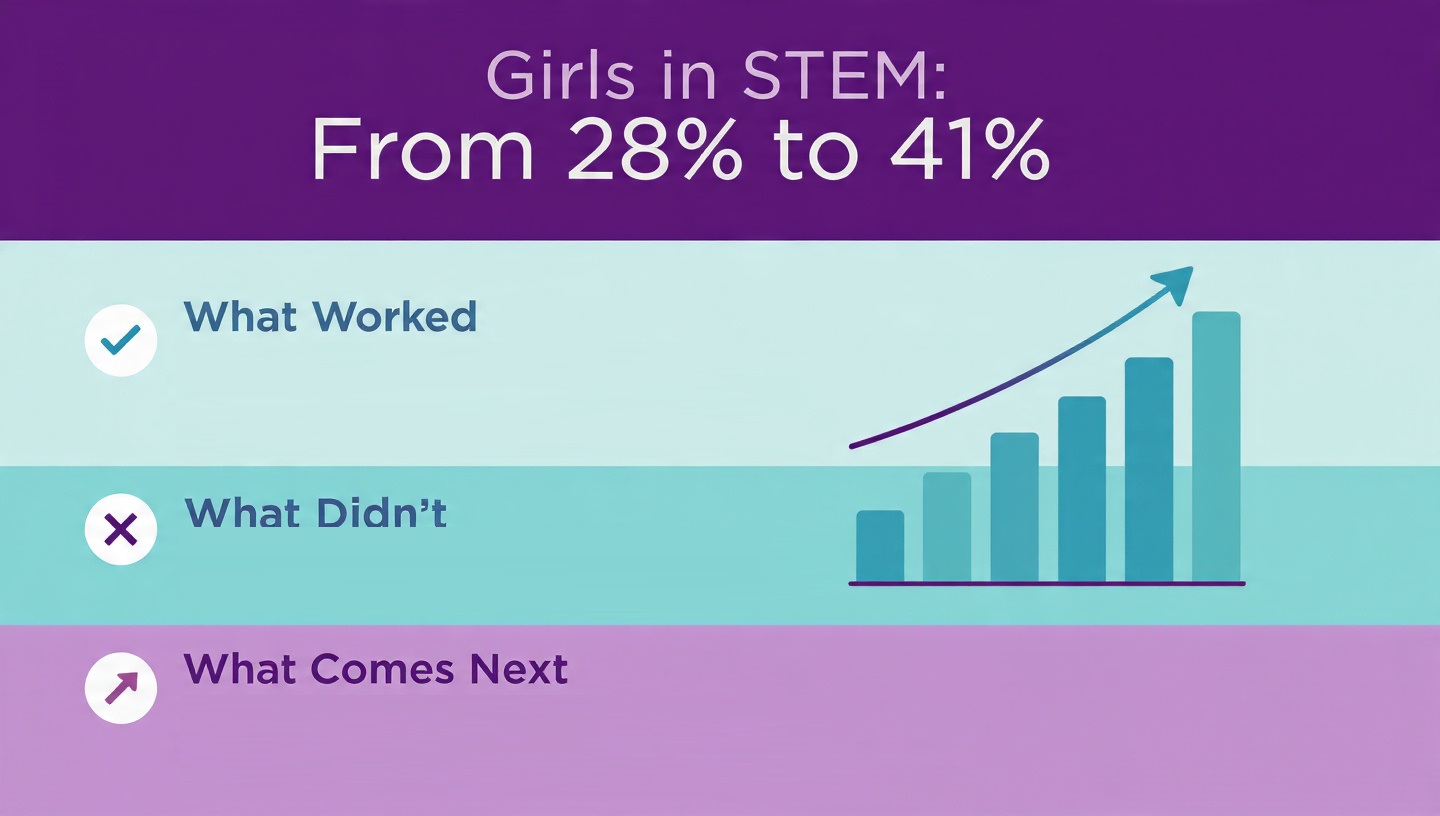
Let me give you the numbers. Between 2018 and 2023, girls’ participation in STEM subjects in Nigerian secondary schools increased from approximately 28% to 41%. That is real progress. That is thirteen percentage points in five years. In a country where girls are still pulled out of school to be married, that number represents thousands of individual battles won by parents, teachers, and the girls themselves.
But forty-one percent is not fifty percent. And in some states—particularly in the Northeast and Northwest—the numbers are still below twenty percent.
So the question I want to ask today is this: what actually worked to move that needle? And what do we do next to get to fifty percent and beyond?
What Worked: Three Things That Actually Moved the Needle
Let me give credit where credit is due. Some interventions have genuinely made a difference.
The first thing that worked was scholarships with conditions. Not general scholarships. Targeted scholarships specifically for girls in STEM, tied to retention. You want the money? You stay in school. You attend classes. You maintain a minimum grade. Organisations like the WAAW Foundation and the Olashore International School scholarship programme have shown that when you remove the financial barrier—school fees, uniforms, books, sometimes even transport—parents who would have married off their daughters instead keep them in school. It sounds obvious, but you would be surprised how many scholarship programmes have no retention mechanism. They give the money and disappear. The programmes that work follow the girl. They check on her. They mentor her. They become her village.
The second thing that worked was visible role models. This one changed everything. For years, the only scientists Nigerian girls saw on television or in textbooks were men. Albert Einstein. Isaac Newton. Thomas Edison. All dead. All white. All men. There was no one who looked like them solving problems that mattered to their communities.
Then organisations like GirlsCoding and STEMettes started bringing real Nigerian women into schools. Women who are engineers at Shell. Women who are data scientists at Flutterwave. Women who build medical devices in their garages. When a girl sees someone who grew up in her city, speaks her language, and now works in a field she never considered, something clicks. It is not abstract anymore. It is possible.
Research from the African Institute for Mathematical Sciences shows that exposure to just one female STEM professional during secondary school increases a girl’s likelihood of pursuing a STEM degree by thirty percent. One person. One visit. Thirty percent.
The third thing that worked was starting early. Primary school early. Not secondary school. By the time a girl gets to JSS1, biases are already formed. Teachers already treat her differently. She already tells herself, “I am not a maths person.”
The programmes that saw the biggest impact—like the Technovation Girls Nigeria chapter—start in primary five and six. They introduce coding as play. They teach robotics as group work. They create an environment where being a girl who is good at science is not weird. It is expected.
What Did Not Work: The Performative Nonsense
I am going to annoy some people here. That is fine.
What did not work? Most of the government’s initiatives. I am sorry, but it is true.
The federal government’s “Girls in STEM” programme—launched with so much fanfare, so many ribbon cuttings, so many photo opportunities—has reached less than five percent of its target. I have seen the reports. Most of the budget went to “awareness campaigns.” Which is a fancy way of saying posters, radio jingles, and per diems for officials who flew to Abuja for meetings.
Posters do not teach girls physics. Radio jingles do not buy lab coats. And per diems do not keep a girl in school when her father says her hand in marriage has been promised.
What else did not work? One-off workshops. A three-day coding camp is lovely. The girls feel inspired. They go home. Then they return to a school with no computers, a teacher who does not know what Python is, and parents who want them to focus on “marriage subjects.” The inspiration lasts about two weeks. Then reality crashes back in.
If you are not changing the environment—the family expectations, the school culture, the community norms—you are just entertaining children for a weekend.
The Real Enemy: Structural Barriers Nobody Wants to Name
Let me talk about the thing nobody wants to name.
The biggest barrier to girls in STEM is not ability. It is not interest. It is not even poverty, although poverty makes everything worse.
The biggest barrier is the belief, held by millions of Nigerian parents and teachers, that a girl’s primary value is marriage and that STEM education is wasted on her because she will eventually “go to her husband’s house.”
I have heard this said. In 2024. By educated people. By a university lecturer who told me, very calmly, that his own daughter would not study engineering because “what will she do with that after marriage?”
I nearly choked.
You cannot technology-fix a cultural belief. You cannot policy-write a worldview. The change has to be slower, harder, and more human.
What works is conversation. Repeated, uncomfortable, persistent conversation. Fathers who need to see their daughters solving problems before they believe. Mothers who need to be reminded that if they had been educated, their lives might be different. Communities that need to see a female engineer come home, build something useful, and be celebrated.
Policy can nudge. But only people can persuade.
What Comes Next: The 2030 Goal
If we want to get to fifty percent—or beyond—by 2030, here is what the next five years must look like.
First, every secondary school in Nigeria should have a girls-in-STEM club. Not optional. Not dependent on a donor. Required. Funded. Inspected. These clubs should meet weekly, have female mentors, and connect with local women in STEM fields.
Second, teacher training. We cannot keep putting girls in classrooms with teachers who believe STEM is for boys. That is sabotage. Every science and maths teacher should undergo gender-bias training. Not a one-hour online module. Real, uncomfortable, reflective training with follow-ups.
Third, parental engagement. Schools should host quarterly STEM open days where parents—especially fathers—are invited to see their daughters build robots, conduct experiments, present projects. You cannot change a father’s mind with a report. You change it when he watches his daughter explain a circuit board better than any boy in the class.
Fourth, financial incentives tied to completion. Not just primary school completion. Secondary school completion. And then tertiary. If we want girls to stay in STEM, we have to acknowledge that their families often lose income by keeping them in school. Pay the family. Not the school. I know that sounds radical. But poverty is radical. Meet it with its own weapons.
A Final Reflection
That physics class I told you about at the beginning? The one with the teacher who didn’t mean harm?
I stayed. I was one of the six girls who made it through the term. And then through the year. And then through university. I am not an engineer. I am a writer. But I did not leave because I was told I could not.
The girls who come after us deserve better than my generation got. They deserve teachers who believe in them. Parents who invest in them. Policies that protect them.
From twenty-eight percent to forty-one percent is progress. But progress is not the same as victory. And victory—real victory—is when a girl who wants to be a chemist is not a statistic. When she is just a student. Just normal. Just one of the crowd.
That is the Nigeria I want to live in. I hope we get there before my daughter is old enough for physics class.