Imagine you want to be a chemist.
Not because your parents forced you. Not because you think it will make money. But because you are genuinely curious about how things work. You want to know what happens when you mix this with that. You want to see a reaction happen in front of you. You want to understand the invisible dance of molecules.
Now imagine that your school has no laboratory.
No beakers. No test tubes. No Bunsen burners. No chemicals. No safety goggles. Just a timetable entry that says “Chemistry Practical” and a teacher who tells you to copy notes from the board because there is nothing to actually do.
This is not a hypothetical. This is the reality for the majority of Nigerian secondary school students. A 2025 survey found that over sixty percent of public secondary schools in Nigeria have no functional science laboratory. None. Zero. Zilch.
So how do these students learn? How do they understand concepts that are fundamentally about observation and experimentation?
For an increasing number of them, the answer is virtual laboratories. Digital simulations that allow them to perform experiments on a screen. Mix chemicals without risk. Change variables without cost. Repeat experiments as many times as they want, until the concept clicks.
And the demand is exploding. Academic literature from 2026 confirms that interest in virtual laboratories is rising rapidly among Nigerian students and educators. A Lagos State initiative called LabXchange, which provides virtual lab simulations, has been accessed by over fifty thousand students since 2024.
But here is the gap I want to talk about today. Awareness is high. Interest is high. Demand is high. But access? Access is still a distant dream for most students.
What Virtual Laboratories Actually Are
Let me explain for anyone who has not seen one.
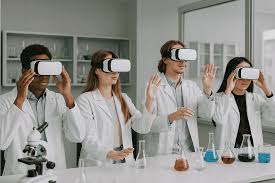
A virtual laboratory is a software simulation. You open it on a computer or a tablet—sometimes even a phone, though it is harder on a small screen. You see a digital representation of a lab bench. There are virtual beakers, virtual test tubes, virtual chemicals, virtual flames. You click and drag to pour this into that. You click a button to heat it. You watch as the simulation calculates what would happen in real life and shows you the result.
If you mix an acid with a base, you see the color change. If you heat a metal, you see it glow. If you add too much of something, you see an explosion—safely, on screen, with no one getting hurt.
These simulations cannot replace the real thing entirely. Nothing beats the feeling of holding a warm test tube in your hand, of seeing a real color change happen slowly, of smelling the gas produced. But when the alternative is nothing—when the alternative is just copying notes from a board—virtual laboratories are a miracle.
A student in a rural school in Katsina can perform the same titration experiment as a student in a private school in Lagos. The private school student has real equipment. The rural student has a simulation. They are not equal. But the rural student at least understands the concept. At least she knows what titration is supposed to look like. At least she is not completely in the dark.
Why Nigerian Students Want This So Badly
I spoke to a secondary school student in Ondo State. Her school has a laboratory building. It was built by a previous administration. It has never been equipped. There are empty cupboards and dusty benches. She has been in that building exactly once, for a tour on the first day of JSS1.
“Every time we have practical,” she told me, “the teacher brings a textbook and reads out what we would see if we had the equipment.”
She paused. Then she said something that broke my heart: “I have never held a test tube. I am in SS2.”
She found virtual laboratories on her own. She does not have a computer, but her phone is enough. She spends hours running experiments, repeating them until she understands. She said her grades have improved dramatically because now she actually knows what the teacher is talking about. Before, she was just memorizing. Now, she understands.
That is what virtual laboratories offer. Not just information. Understanding. The chance to see, to do, to fail, to try again—all the things that make science science.
The Gap: Awareness Without Access
Here is the frustrating part. Virtual laboratories are not expensive. Many of the best ones are completely free. PhET simulations from the University of Colorado, for example, are used by millions of students worldwide and cost nothing to access. LabXchange is free. The Royal Society of Chemistry has free simulations. There is no shortage of quality, free, accessible virtual lab tools.
So why is there a gap?
Because free on the internet is not the same as free in practice. The real barriers are not the cost of the software. They are the cost of everything around it.
First, devices. A smartphone can run basic simulations, but the screen is small. Clicking and dragging precise amounts of virtual chemicals with your thumb is frustrating. A tablet or a laptop would be better. Most students have neither.
Second, data. Running simulations uses data. Not a huge amount, but enough that a student who buys 1GB for a week will think twice before spending it on virtual experiments instead of WhatsApp or Instagram.
Third, electricity. Simulations do not work on a dead battery. And in many parts of Nigeria, charging your phone is not guaranteed. You might have power for two hours today and not again until tomorrow. That makes it hard to build a consistent learning habit.
Fourth—and this is the one that gets me—awareness. Even when teachers know about virtual labs, many do not know how to integrate them into teaching. They do not know which simulations are good. They do not know how to assign virtual lab work as homework. They do not know how to assess whether a student actually learned anything from the simulation. So they just … do nothing. They stick to the textbook. They stick to the notes. They stick to what they know.
What Educators Are Saying
I attended a conference on science education in Abuja last year. The topic of virtual laboratories came up. The room—filled with principals, teachers, and ministry officials—was divided.
The younger teachers were excited. They had already started using simulations with their students. They were seeing results. Students who used to fail practical exams were now passing. Students who used to hate science were now curious.
The older teachers were skeptical. “It is not the same as the real thing,” one said. “You cannot teach laboratory safety on a screen.” Another said, “How do we know the students are actually learning and not just clicking randomly?”
Both points are fair. But here is my response: the alternative is nothing. No real thing exists. No laboratory safety is being taught because there is no laboratory. No one is checking whether students are learning because the current method—copying notes—produces zero learning anyway.
Virtual laboratories are not perfect. But perfect cannot be the enemy of good. Not when millions of Nigerian students have never held a test tube.
The Lagos Experiment
Let me give you a positive example so this article is not all doom and gloom.
Lagos State launched its LabXchange initiative for secondary schools in 2024. The idea was simple: provide virtual lab access to all public secondary school students, train teachers on how to use it, and track outcomes.
The early results are promising. Over fifty thousand students accessed the platform in the first year. Teachers reported improved student engagement in science classes. Exam scores in practical sciences showed modest but measurable improvement.
Was it perfect? No. Many schools did not have enough devices for all students. Internet connectivity was inconsistent. Some teachers never completed the training. But it was a start. It was the government doing something instead of nothing.
The lesson from Lagos is that virtual laboratories are not a magic bullet. They are a tool. And like any tool, they work only when you also invest in training, devices, connectivity, and ongoing support. If you just send a link and walk away, nothing changes.
What Needs to Happen Next
I am going to make three recommendations. Take them or leave them.
First, the federal government should mandate that every secondary school—public and private—has access to virtual laboratory platforms. Not as a replacement for physical labs, but as a minimum standard where physical labs do not exist. This costs almost nothing in software terms. The barrier is not money. It is will.
Second, teacher training programmes must include virtual laboratory integration. Right now, most teacher training colleges do not even mention virtual labs. That is ridiculous. Every science teacher graduating today should know how to use PhET, LabXchange, and other free tools. They should know how to assign virtual lab homework. They should know how to assess it.
Third, NGOs and tech companies should focus on offline-first solutions. Many students and schools have no reliable internet. A virtual lab platform that can be downloaded once and used offline—on a school server, on a teacher’s laptop, even on a student’s phone—would reach millions who are currently excluded. This is not technically difficult. It just requires someone to prioritize it.
A Student’s Plea
Let me end the way I started. With a student.
The girl from Ondo State—the one who has never held a test tube—she is now in SS3. She wants to study biochemistry at university. She has never performed a real titration. She has never seen a real enzyme reaction. She has never held a real pipette.
Everything she knows, she learned from a screen.
She told me: “I know it is not the same. But what else can I do? I want to be a scientist. I will not let the absence of a laboratory stop me.”
That is the spirit we need. That is the determination that will carry Nigeria forward. But she should not have to fight this hard just to learn what a test tube feels like.
Give her a virtual lab today. Give her a real lab tomorrow. But do not give her nothing.