Let me tell you something that might get me in trouble with academics.
The Nigerian university textbook is dead. Or dying. Or at the very least, gasping for breath in an ICU bed that no one is paying attention to.
I know that sounds dramatic. But spend one week with a Nigerian undergraduate in 2026 and tell me I am wrong.
I did exactly that. I sat with a 300-level computer science student at a federal university—I will not name which one, because I am not here to embarrass anyone specifically. He showed me his phone. His phone had more learning material than the entire university library. PDFs of international textbooks. YouTube playlists of MIT lectures. Tutorials on Python and machine learning. AI tools that answered his questions instantly, in plain Nigerian English, with examples he actually understood.
He told me: “The last time I opened a university-recommended textbook was first year. They are too old. The examples are from 2014. The lecturer wrote half of them himself and they are not even good.”
I asked him when he last attended a lecture. He laughed. Not a happy laugh. A tired laugh.
“I attend the ones with attendance,” he said. “The rest, I just learn on my own. Google. YouTube. ChatGPT. There is a Discord server where people from all over Africa share resources. I learn more there in one week than in one semester here.”
That student is not lazy. He is not a rebel. He is a pragmatist. He has figured out that his university—the institution his parents are paying fees for, the institution that will hand him a degree—is no longer the best place to learn.
And that is the crisis Nigerian universities are refusing to see.
The Global Shift Nigerian VCIs Are Ignoring
Around the world, universities are restructuring. Not slowly. Desperately.
The University of Southern California spent $1 billion on an AI computing centre. Harvard introduced AI tutors for introductory computer science courses—and saw failure rates drop significantly. Cambridge is redesigning its entire curriculum around the assumption that students will use AI as a research assistant.
Meanwhile, in Nigeria? We are still debating whether students should be allowed to use their phones in class. We are still treating Wikipedia like it is the enemy. We are still forcing students to buy textbooks written in 2012 by local authors who have not updated the content in ten years.
I spoke to a professor at a university in the Southwest. Off the record. He told me: “Our curriculum review cycle is seven years. Seven years. By the time we approve a new curriculum, the technology it describes is already two generations old.”
He said his department still teaches COBOL. COBOL. A programming language developed in 1959.
I asked him why. He shrugged. “Because the lecturers know it. Because no one wants to learn new things. Because the system does not reward innovation. It rewards seniority and publications in local journals that no one reads.”
That is not a university. That is a museum.
What Nigerian Students Are Actually Doing
Let me paint you a picture of the average Nigerian STEM student in 2026.
She wakes up. She checks her phone. She has notifications from three different learning platforms. Coursera sent her a reminder about her machine learning assignment. YouTube recommended a new tutorial on data structures from an Indian creator she follows. Her AI tutor—she pays for it monthly with her data business earnings—has generated practice questions for her upcoming exam.
She spends two hours learning online. Then she goes to class. In class, the lecturer spends forty minutes reading from a PDF of a textbook published in 2015. He does not take questions. He ends early because he has a meeting.
After class, she goes back to her room and continues learning from her phone.
She is not cheating. She is surviving. She is taking responsibility for her own education because her university has abdicated that responsibility.
And here is the kicker: she is not special. She is one of thousands. This is the normal, hidden, shadow education system that has grown up alongside our formal universities.
The Three Ways AI Is Transforming Learning (Whether Universities Approve or Not)
Let me name the three specific ways AI has already replaced traditional university functions.
One: personalised tutoring.
When I was in university, if I did not understand a concept, I had two options. Ask the lecturer—which meant competing with two hundred other students for attention—or find a textbook and read the same explanation over and over until it made sense. Now? A student types “explain quantum mechanics like I am fifteen” into an AI tool, and it does exactly that. Different analogies. Different speeds. Different examples. Personalised to exactly what that student needs at that moment. A lecturer cannot do that for two hundred students. AI can.
Two: instant feedback.
Traditional education has a terrible flaw: by the time you get feedback on an assignment, you have already moved on. The mistake is forgotten. The learning moment is gone. AI tools provide instant feedback. A student writes a physics solution. The AI checks it immediately, explains the error, and generates similar problems until the student masters the concept. That is not cheating. That is a teaching assistant who works twenty-four hours a day and never gets tired.
Three: access to global knowledge.
The university library is limited. Even a good one. It has the books someone decided to buy. The journals someone decided to subscribe to. The internet has everything. AI tools search that everything, synthesise it, and present it in the language and format the student needs. A student in Maiduguri can now access the same quality of information as a student in Massachusetts. That was not true five years ago. It is true now.
What Nigerian Universities Must Do Before 2030
I am not here to just complain. I am here to say what needs to happen.
First, curriculum reform every two years, not every seven. Technology moves faster than bureaucracy. If your curriculum review cycle is longer than a presidential term, you have already lost. Universities need the authority to update courses without waiting for national committees and senate approvals that take years. Let departments experiment. Let them fail fast and fix faster.
Second, AI literacy for lecturers. Most Nigerian lecturers do not know how to use AI tools. They cannot teach what they do not know. Universities must invest in training—real training, not a two-hour workshop with a certificate—to bring every lecturer up to speed on what AI can do, what it cannot do, and how to integrate it into teaching.
Third, assessment reform. You cannot give take-home essays anymore. AI will write them. That does not mean you ban AI. It means you change the question. Instead of “describe the causes of the civil war,” you ask “using AI as a research assistant, build a timeline of events leading to the civil war with cited sources from at least three Nigerian historians.” You test the process, not just the product. You test critical thinking, not just recall.
Fourth, infrastructure that costs less than you think. The excuse I hear most often is “we have no money for technology.” But AI tools cost nothing. Most have free tiers. A smartphone costs less than a textbook these days. The barrier is not money. The barrier is mindset. The barrier is lecturers who do not want to learn. The barrier is administrators who would rather protect their power than serve their students.
A Vision for 2030
Imagine a Nigerian university in 2030 that actually adapted.
Every student has an AI tutor personalised to their learning pace. Lecturers do not lecture. They facilitate. They lead discussions. They mentor. They spend their time on what humans are good at—connection, inspiration, difficult questions—and let AI handle what machines are good at—drill, repetition, basic explanation.
Assessment is continuous and authentic. No single high-stakes exam. No regurgitation of notes. Students build portfolios. They solve real problems. They work in teams. They present to panels of industry professionals.
Graduates leave with not just a degree, but a demonstrated ability to learn new things, work with AI tools, and adapt to a rapidly changing world.
That university would not just survive. It would dominate. Students would beg to attend. Employers would beg to hire its graduates.
The Alternative
The alternative is that Nigerian universities continue doing what they are doing.
Continue teaching COBOL in 2030. Continue forcing students to buy outdated textbooks. Continue treating phones as enemies instead of tools. Continue pretending that AI is a passing fad or a cheating device.
And then, sometime around 2030, something will snap. Employers will stop caring about degrees from universities that teach obsolete skills. Students will stop enrolling because why pay for four years of irrelevance when you can learn online for free? And the university system will collapse—not because of funding, not because of strikes, but because it refused to change.
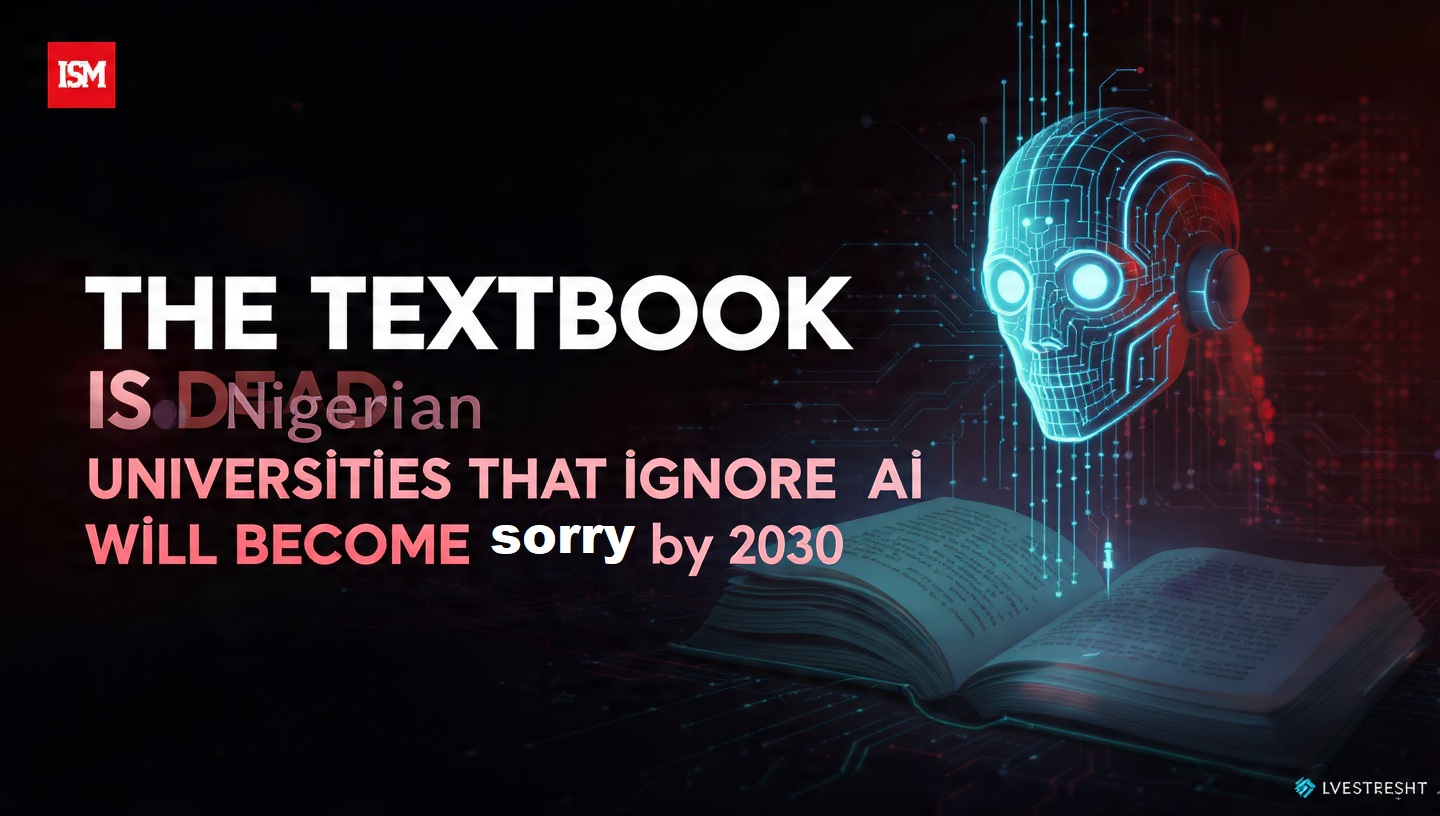
The textbook is dead. The lecture is dying. The university that ignores AI will follow them to the grave.
The only question is whether Nigerian universities will be among the survivors or the fossils.