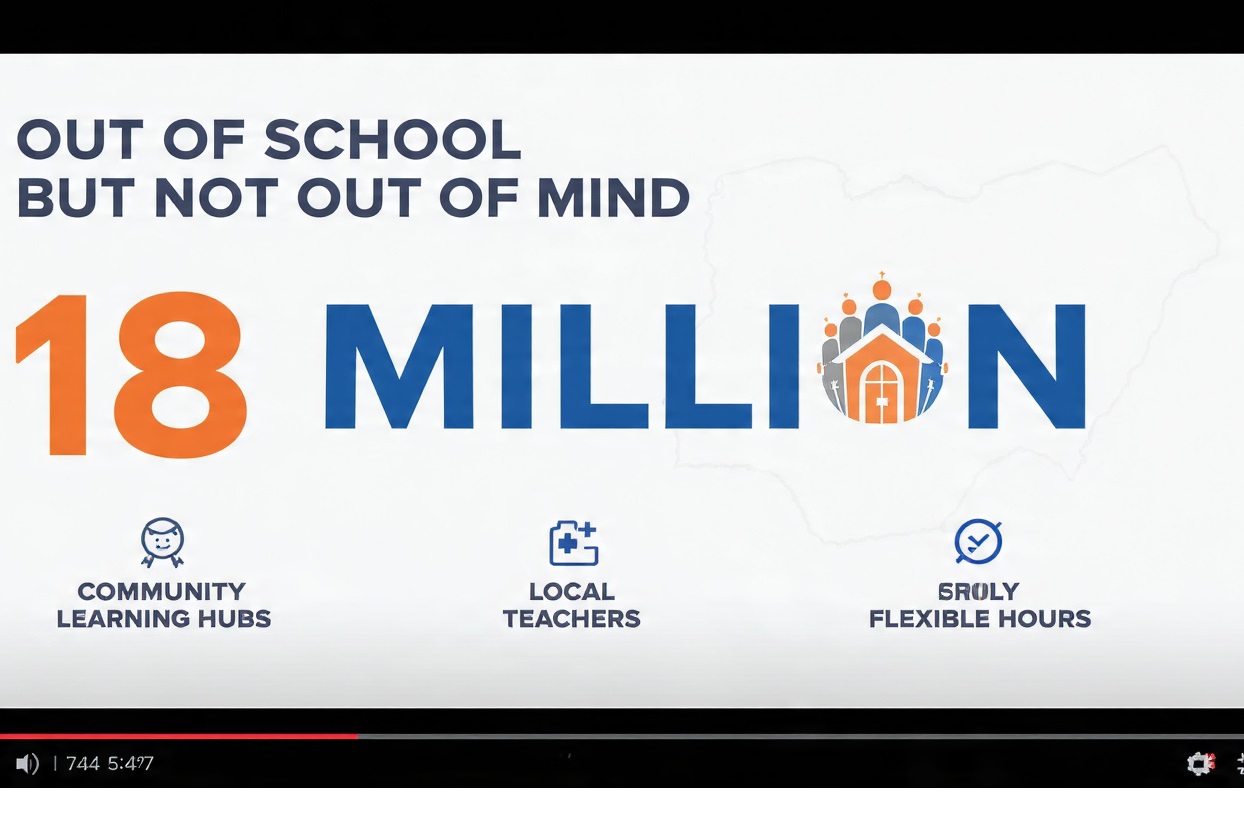
Let me just start by saying something that might annoy you: 18 million out-of-school children is not just a statistic. It is a national embarrassment.
Every time UNESCO drops that number, we shake our heads on Twitter, the minister releases a statement about “ongoing reforms,” and then we all move on with our lives. But those 18 million children? They don’t move on. They stay exactly where they are—on the streets, in markets, on farms, or worse, becoming recruitment targets for people who don’t have their best interests at heart.
I have travelled across this country. From the IDP camps in Maiduguri to the floating slums of Makoko, from the Almajiri systems in Kano to the fishing villages in Bayelsa. And let me tell you what I have seen: children who want to learn but have no one to teach them. Children who wake up every morning knowing that today will be exactly like yesterday—no book, no slate, no chalkboard, no future.
The federal government loves to talk about Universal Basic Education. They love to cut ribbons on new schools that never get furnished. They love to announce policies that sound good on paper but collapse the moment you try to implement them in a village without electricity or internet.
Meanwhile, something interesting is happening on the ground. Something the politicians didn’t plan and the technocrats didn’t design. Ordinary Nigerians are building their own solutions.
The Community Learning Hub That Changed Everything
Two years ago, I visited a community in the outskirts of Kaduna. No proper school for kilometers. The closest government primary school had three teachers for seven classes, and two of those teachers hadn’t been paid in four months. You can imagine the attendance.
But there was this woman—Hajiya Aisha, her name was. She had converted the front room of her house into what she called a “learning hub.” Not a school, because she wasn’t licensed to call it that. Just a room with a few benches, a blackboard she bought from her husband’s transport money, and some textbooks that neighbours had donated.
She taught seventeen children. Not for money—some parents gave her rice or tomatoes when they could. She taught them because she said, and I quote: “If I don’t teach them, who will?”
What Hajiya Aisha was doing, quietly and without any government recognition, is what education experts are now calling the community learning hub model. And it is spreading like harmattan fire across Nigeria.
From the churches in the East that run after-school literacy programmes to the mosques in the North that have started integrating basic numeracy with Quranic education, from the retired civil servants in the West who open their gates every afternoon to neighbourhood children—ordinary Nigerians are refusing to wait for the government to save their kids.
Why This Model Works When Schools Fail
Let me break this down for you. The community learning hub model works for four very simple reasons.
One: it is where the children already are. These hubs don’t ask children to walk ten kilometers to a school that might or might not be open. They come to the children. They set up in the neighbourhood, the village, the camp, the slum. Proximity matters when you are a child whose parents can’t afford transport fare.
Two: it is flexible. A formal school runs on a rigid timetable. 8 am to 2 pm, Monday to Friday. But a child who hawks pure water in the morning and helps their mother at the market in the afternoon cannot keep that schedule. Community hubs run when children are available. Morning shifts. Evening shifts. Weekend sessions. They adapt to poverty, not the other way around.
Three: it is accountable. Government teachers who haven’t been paid in months? They stop showing up. But a community hub run by a woman whose own children are in that room? She is showing up. Her neighbours are watching. There is social accountability that no amount of civil service bureaucracy can replicate.
Four: it is culturally intelligent. I have seen Almajiri programmes that try to force Western curriculum on children whose entire worldview is shaped by Quranic education. It never works. But community hubs? They integrate. They teach Quranic recitation in the morning and basic mathematics in the afternoon. They respect what parents already value while adding what children are missing.
The Numbers Nobody Wants to Talk About
Let me give you some hard truths.
Sixty percent of those 18 million out-of-school children are girls. That is not an accident. That is policy by neglect. When a family has to choose which child to send to school, they send the boy. Every time. I have sat in village meetings where men openly said, “Why educate a girl? She will just get married and go to her husband’s house.”
So any solution that does not specifically address the girl child is not a solution at all. It is performative nonsense.
Here is another hard truth. The Almajiri system alone accounts for over 9 million children. Boys sent away from their families to study under Mallams, many of whom end up begging on the streets because their Mallams cannot feed them. The federal government has tried to reform this—UBEC has an Almajiri education programme—but it has barely scratched the surface. Corruption, lack of political will, and the sensitivity of touching a religious institution have all slowed progress.
And here is the hardest truth of all. Even if every single community hub in Nigeria expanded tomorrow, we would still have millions of children left behind. Because community hubs require community capacity. And many communities—especially in the Northeast where insurgency has destroyed everything—have no capacity left. No buildings, no literate adults, no resources, no hope.
What Actually Needs to Happen
I am not naive. I know that community learning hubs are not a complete solution. They are a stopgap. A bridge. A way to keep children alive to learning until the government finally does its job.
But here is what I believe: while we wait for the government to get its act together—which, let’s be honest, could take another twenty years—we should be investing everything we have into these hubs.
First, the government should stop competing with community hubs and start partnering with them. Instead of building new schools that end up empty, give that money to existing hubs. Provide them with materials. Train their volunteer teachers. Pay them a small stipend so they don’t have to choose between teaching and feeding their own children.
Second, technology. I know you might be tired of hearing about AI and digital tools. But even the most basic technology—a solar-powered tablet loaded with offline educational content—can transform a hub run by a semi-literate volunteer into a genuine learning centre. We don’t need fibre optics in every village. We need practical, durable, offline-first solutions that work in the real Nigeria.
Third, community ownership. Top-down doesn’t work. It has never worked. The hubs that survive are the ones the community built for itself. So any intervention—government or NGO—must start with the question: what do you already have, and how can we support it? Not: here is our programme, fit into it.
A Story That Gives Me Hope
I want to end with a story about a girl named Fatima.
Fatima is twelve years old. She used to sell groundnuts at a bus stop in Zaria. She had never been to school. Her father said there was no point.
There was a learning hub in her neighbourhood run by a retired primary school teacher. Three afternoons a week, from 3 pm to 6 pm. Fatima started going because her friend was going. Her father didn’t know at first.
Within six months, she could read and write Hausa. Within a year, she was helping younger children with their numbers. Her father found out. Instead of being angry, he cried. He had never seen his daughter read anything.
Fatima is now in a formal school. She is eleven years behind her peers. But she is there. And she will not stop.
That is what community learning hubs do. They buy children time. They keep the door open until the child can walk through it properly.
Eighteen million children is a crisis. But eighteen million Fatimas is also a possibility. We just have to stop waiting for permission to act.