By Tom Chiahemen –
In Chinua Achebe’s Things Fall Apart, the wrestling arena was more than a place where strong men tested their physical prowess. It was a theatre of honour, discipline and communal values. There were rules. There were spectators. There was a referee. Above all, there was an understanding that no wrestler, however formidable, was greater than the traditions that governed the contest.
That timeless lesson suddenly came alive for me after reading two Facebook posts on Monday.
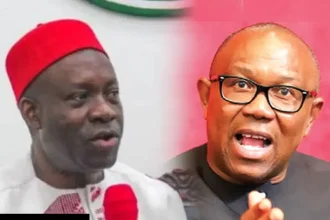
Written independently by respected journalist Udo Silas and former Minister of Youth and Sports Development, Comrade Solomon Dalung, the two interventions are stylistically different yet remarkably complementary. One is steeped in literature and symbolism; the other rests on constitutional accountability and democratic transparency. Yet both illuminate the same emerging reality.
The political contest for Nigeria’s 2027 presidency has begun.
Not in campaign grounds.
Not in party primaries.
But in the battle to define the narrative.
Udo Silas, in his beautifully crafted essay titled “As Life Presidency Arrives Our Shores (2): Okonkwo and Amalinze – Understanding Tinubu’s Imagery of the Wrestler,” draws inspiration from President Bola Ahmed Tinubu’s declaration that he would “wrestle” his political opponents to the finish.
To many, it may have sounded like ordinary political bravado.
To Udo, however, it was far more profound.
Borrowing richly from Achebe’s literary masterpiece, he recreates the famous wrestling duel between Okonkwo and Amalinze the Cat before reminding readers of the tragic turning point in Okonkwo’s life—the killing of Ikemefuna despite repeated warnings from the elders.
It is here that literature transcends fiction and becomes political philosophy.
The warning from Achebe’s Umuofia is timeless.
Strength is admirable.
Determination is commendable.
Victory is desirable.
But power that refuses restraint eventually consumes itself.
When leaders begin to believe that every contest must end only in their favour, democracy itself begins to suffocate.
Udo captures this anxiety with remarkable elegance.
“The drums are beating again,” he writes.
“Not the gentle drums of harvest, but the iron-throated drums of contest.”
It is difficult to read those words without sensing that they describe not merely political competition but an atmosphere already thick with apprehension.
Perhaps the most powerful line in his essay is the reminder that “wrestling is not war.”
That simple statement carries profound implications for democratic governance.
In every genuine democracy, elections are contests—not conquests.
Opponents are rivals—not enemies.
Institutions are expected to serve as impartial referees—not extensions of partisan interests.
The arena belongs to the people, not to any one contestant.
Almost seamlessly, Solomon Dalung’s intervention provides the constitutional counterpart to Udo’s literary allegory.
His concern is not wrestling metaphors or political imagery.
It is documentation.
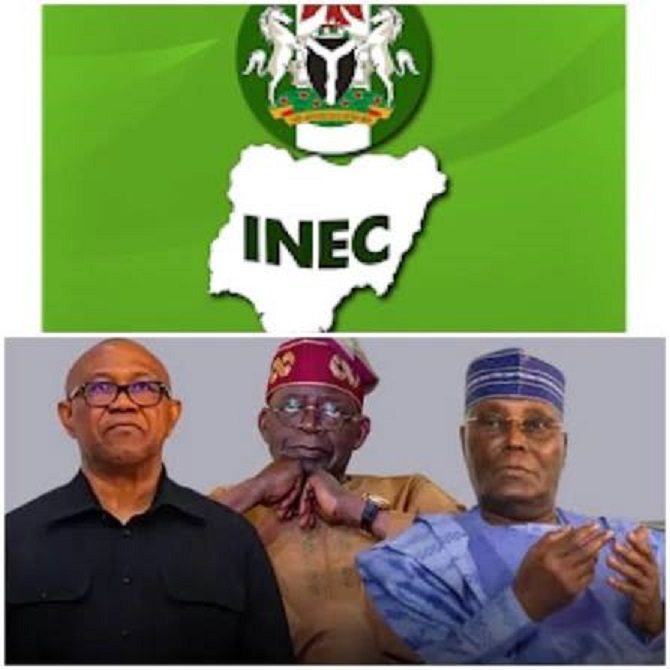
Reacting to President Tinubu’s published particulars reportedly released by the Independent National Electoral Commission (INEC), Dalung observes that the sections relating to the President’s primary and secondary school qualifications were reportedly left blank while only the university qualification was listed.
Dalung is careful.
He makes no accusation.
He pronounces no verdict.
Instead, he asks what should ordinarily be regarded as a legitimate democratic question.
Why?
His argument is disarmingly simple.
If public records, affidavits and educational declarations have consistently been used to scrutinise political opponents, then fairness demands that the same standard be applied to the incumbent President.
No exceptions.
No sacred cows.
No selective accountability.
Whether one agrees with Dalung’s premise is almost secondary.
The larger issue he raises is one upon which every constitutional democracy depends: public office attracts public scrutiny.
Questions are not acts of rebellion.
They are instruments of accountability.
Transparency is not a favour bestowed upon citizens.
It is an obligation owed to them.
Silence, especially where clarity is possible, rarely settles public debate. More often, it deepens suspicion.
Read independently, Udo Silas and Solomon Dalung appear to be discussing different issues.
Read together, they become two chapters of the same political conversation.
One interrogates the psychology of power.
The other interrogates the responsibility that accompanies power.
One asks whether the contest itself will remain fair.
The other asks whether those seeking authority are willing to subject themselves to the same standards they demand of others.
Together, they point to what may become the defining question of the 2027 presidential election—not simply who wins, but how victory is achieved.
This is why the accompanying political cartoon beneath Udo’s post is particularly instructive.
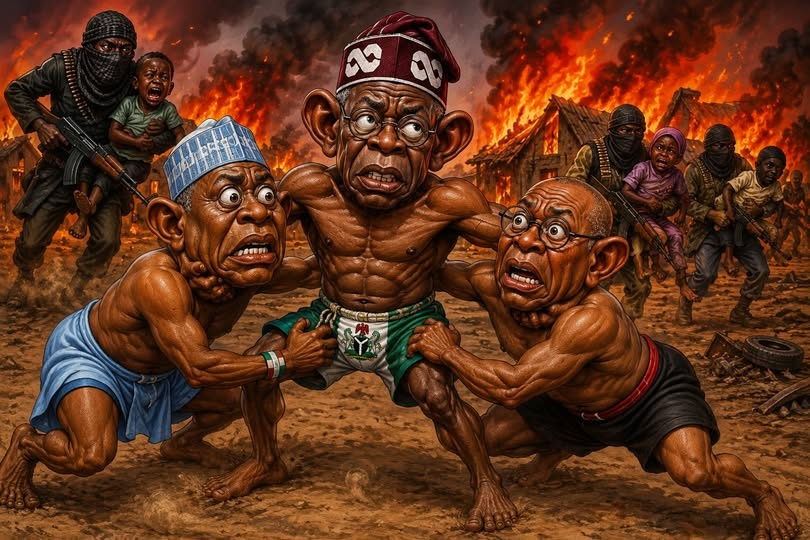
Inside the wrestling ring stands President Tinubu, facing two leading opposition figures—Atiku Abubakar of the African Democratic Congress (ADC) and Peter Obi of the Nigerian Democratic Congress (NDC). Around them sit ordinary Nigerians, security personnel included, watching intently.
Yet the cartoon’s true subject is not the wrestlers.
It is the arena.
The spectators are not merely observing who throws the first punch.
They are watching whether the referee remains impartial.
Whether the rules are respected.
Whether the contest remains credible.
That, ultimately, is where democracies either flourish or fail.
History offers sobering lessons.
Nations rarely lose democracy in one dramatic moment.
More often, democratic erosion begins quietly—through weakened institutions, diminished transparency, selective application of rules and growing public distrust.
By the time the damage becomes obvious, rebuilding confidence has become infinitely more difficult.
This is why thoughtful interventions such as those of Udo Silas and Solomon Dalung deserve engagement rather than dismissal.
One speaks through the enduring wisdom of literature.
The other through the language of constitutional responsibility.
Neither should be reduced to partisan talking points.
Both are reminders that democracy survives not because leaders are strong, but because institutions are stronger.
The drums announcing Nigeria’s 2027 presidential contest have already begun to beat.
Whether they herald another credible democratic transition or a bruising struggle over the country’s political soul will depend on far more than campaign slogans, political alliances or electoral arithmetic.
It will depend on whether every actor—government, opposition, electoral umpire, security agencies, the judiciary, the media and the electorate—accepts one fundamental truth that Achebe understood so well.
No wrestler is greater than the arena.
And no democracy survives when the arena itself becomes the prize.