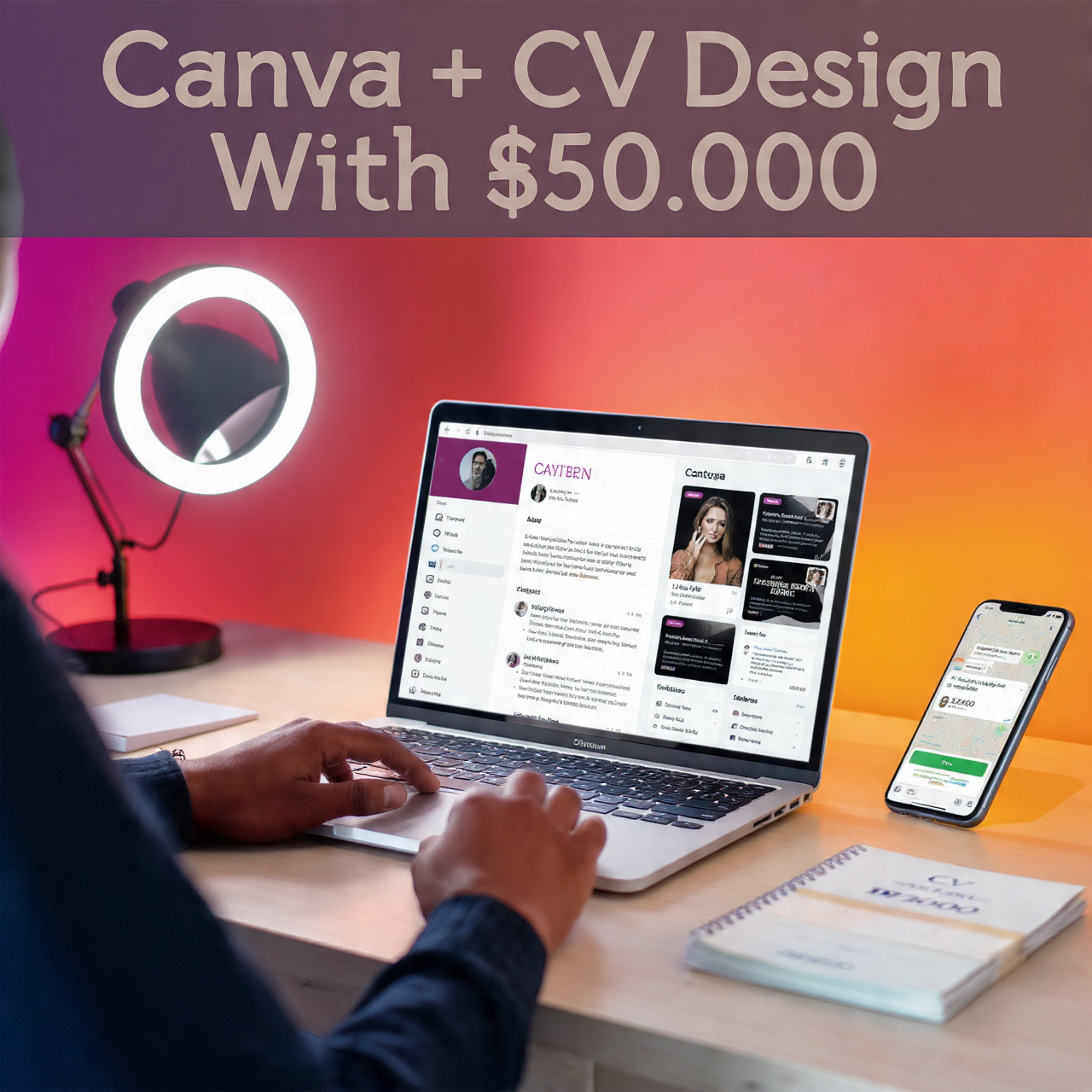
One of the most interesting businesses you can start in Nigeria in 2026 doesn’t require a shop, warehouse or imported inventory.
It requires a laptop or smartphone, an internet connection and a skill people are willing to pay for.
That skill could be graphic design.
It could be CV formatting.
It could be social media content creation.
Or, more realistically, it could be a combination of several simple digital services packaged for a specific audience.
That’s the idea behind the Canva + CV business model.
The concept is not to become an expert designer overnight.
Instead, you identify everyday problems that individuals and small businesses have and use accessible digital tools to solve them.
A job seeker needs a professional CV.
A small business needs a flyer.
A restaurant needs social media posts.
A consultant needs a presentation.
A church or event organiser needs promotional graphics.
Many of these customers don’t want to hire a large agency.
They want someone who can deliver a good result quickly at a price they can afford.
The ₦50,000 Test
A sample startup budget could look like:
- ₦12,000 — design and productivity software
- ₦5,000 — simple portfolio website
- ₦5,000 — initial social media promotion
- Remaining funds — internet/data, transportation and contingency
The important thing is that you don’t necessarily have to spend the entire ₦50,000.
In fact, one of the advantages of a service business is that you can preserve some capital because you aren’t purchasing physical inventory.
Your inventory is essentially your skill and time.
The Three Services
A simple starting package could include:
CV/Resume Design
Approximate starting price: ₦8,000
Business Flyer
Approximate starting price: ₦5,000
Social Media Content Package
10 posts for approximately ₦15,000
Prices aren’t universal.
They should change based on quality, turnaround time, complexity, customer type and market.
The point is to create clear products instead of telling customers:
“I do graphic design.”
That’s too broad.
A customer should immediately understand what they’re buying.
Why Packaging Matters
Imagine two freelancers.
Freelancer A says:
“I offer graphic design services.”
Freelancer B says:
“I create professional CVs for Nigerian job seekers, business flyers for SMEs and monthly social media content packages.”
The second freelancer is easier to understand.
Clear positioning reduces the amount of explanation required during sales conversations.
It also makes advertising easier.
Starting With CV Design
CV design can be an attractive entry-level service because people are constantly applying for:
- Jobs
- Internships
- Graduate programmes
- NYSC opportunities
- Scholarships
- Professional positions
But there’s an important distinction.
A good CV isn’t simply a colourful document.
The objective should be to present relevant information clearly and professionally.
For many applicants, excessive graphics, unusual layouts and poor formatting can make a CV harder to read.
A professional CV should generally prioritise:
- Clear structure
- Relevant experience
- Achievements
- Skills
- Education
- Consistent formatting
- Appropriate keywords
- Easy readability
Don’t Promise Jobs
This is an important business rule.
A CV designer should never tell customers:
“I guarantee you’ll get the job.”
You can’t control the employer’s decision.
Instead, the service can promise something you actually control:
A professionally structured, readable CV tailored to the customer’s target role.
That is more credible.
The ATS Question
Many employers use applicant tracking systems or recruitment software to process applications.
That doesn’t mean every “ATS-friendly” CV must be ugly.
A clean structure can make information easier for both software and human recruiters to process.
The focus should be on:
- Appropriate headings
- Relevant keywords
- Clear job titles
- Correct dates
- Readable formatting
- Avoiding unnecessary visual clutter
Don’t sell ATS as a magic system that guarantees an interview.
It isn’t.
Building a Portfolio Without Customers
One of the biggest problems new freelancers face is:
“How can I get clients when I have no previous clients?”
Create sample projects.
You could create:
- Three fictional CV redesigns
- Three business flyers
- A restaurant social media pack
- A real estate promotional design
- A small business branding sample
Clearly label fictional work as sample projects.
The objective is to demonstrate what you can do.
A potential customer doesn’t necessarily need to know that your first portfolio contained no paid clients.
They need to see evidence that you can produce a professional result.
Before-and-After Content
One of the most effective ways to market design services is to demonstrate improvement.
For example:
Before: Poorly formatted CV.
After: Clean, professional version.
Or:
Before: Crowded business flyer.
After: Clear promotional design.
This creates visual proof.
Instead of saying:
“I’m a good designer.”
You’re showing the customer.
LinkedIn Can Become a Sales Channel
For CV services, LinkedIn is particularly useful because your potential customers already include professionals and job seekers.
You can publish educational posts such as:
“Five CV mistakes that make recruiters work too hard.”
Or:
“Your CV says you’re hardworking. Here’s a stronger way to demonstrate it.”
The content itself becomes marketing.
Someone reads your advice.
They check your profile.
They see your portfolio.
Then they contact you.
This is much stronger than repeatedly posting:
“I design CVs. DM me.”
The 50-DM Strategy
Direct outreach can work, but it should be personalised.
Instead of sending 50 identical spam messages, identify small businesses or professionals who could genuinely benefit from your service.
For example:
“I noticed your business is promoting several services online. Your current flyer contains useful information, but the layout could be easier to scan on mobile. I created a quick redesign concept. If you like the direction, I can develop the full version.”
That’s significantly better than:
“Hello sir, I do graphics. Do you need flyer?”
The first message demonstrates observation and value.
Free Samples Need Boundaries
Offering a sample can help you acquire your first customers.
But don’t spend hours doing free work.
A useful rule could be:
Small preview → customer approves direction → paid project begins.
For example, you might redesign one section of a CV or create a rough flyer concept.
Don’t provide an entire campaign for free.
Otherwise, you’re running a free agency.
How to Handle Revisions
This is one of the biggest hidden problems in freelance design.
A customer pays ₦5,000 and then requests:
- New colours
- New font
- New logo
- Different layout
- New photographs
- Different wording
- Completely different concept
Suddenly a five-thousand-naira job consumes six hours.
Create a revision policy.
For example:
Basic package: One revision.
Standard package: Two revisions.
Premium package: Three revisions.
Additional revisions attract an extra fee.
The exact numbers can vary, but the principle is important.
Don’t Underprice Yourself Forever
Low introductory prices can help you get initial customers.
But there is a danger.
If you charge ₦2,000 forever, customers may associate your brand with cheap work.
Instead, use early jobs to develop:
- Portfolio
- Testimonials
- Processes
- Confidence
- Speed
Then gradually increase prices.
A freelancer who can complete a professional CV in two hours is in a different position from someone who takes eight hours.
As your efficiency improves, your effective hourly income can increase.
The Real Money Is in Recurring Clients
Individual CV orders are useful.
Recurring business clients can be even more valuable.
Consider a small company that needs:
- 12 social posts per month
- Promotional flyers
- Recruitment graphics
- Event banners
- Occasional document formatting
Instead of selling one flyer for ₦5,000, you could create a monthly package.
For example:
SME Content Package
- 20 social media designs
- 4 promotional flyers
- Basic content calendar
- Monthly revisions
A package could be priced according to workload and complexity.
The exact price isn’t the important part.
Recurring revenue is.
From Freelancer to Micro-Agency
Once you have several clients, you may discover that your biggest problem isn’t finding customers.
It’s delivering everything yourself.
That’s when outsourcing becomes useful.
You could eventually have:
You: Sales + customer relationships
Designer: Graphic production
Writer: Captions and copy
Video editor: Short-form content
Instead of being the person doing every task, you become the person managing the system.
That’s how a simple Canva service can eventually become a small creative agency.
The ₦150,000 Monthly Model
Here’s a simple example.
Suppose you have:
Five monthly clients × ₦30,000 = ₦150,000 revenue.
But don’t automatically call the entire ₦150,000 profit.
You may have:
- Internet costs
- Software subscriptions
- Freelancers
- Advertising
- Payment fees
- Equipment
- Other operating expenses
The important lesson is that recurring packages make revenue more predictable.
What About AI?
AI has changed the design industry.
That’s not necessarily bad news.
Instead of competing against AI, freelancers can use AI as part of their workflow.
For example:
- Generate content ideas
- Draft social captions
- Brainstorm campaign concepts
- Create variations
- Research target audiences
- Improve productivity
But the customer is paying for an outcome.
They aren’t necessarily interested in which tool you used.
Your responsibility is to ensure the final work is accurate, original enough for its intended purpose and suitable for the customer’s brand.
Don’t simply copy AI-generated content and deliver it without checking.
Common Mistakes Beginners Make
Mistake 1: Offering Everything
“Logo, website, CV, video, app, animation, printing, SEO, photography…”
This makes positioning difficult.
Start with a few services.
Mistake 2: No Portfolio
Customers need evidence.
Build sample work.
Mistake 3: No Deposit
For larger projects, consider requiring a deposit before beginning.
Mistake 4: Unlimited Revisions
Set boundaries.
Mistake 5: Underpricing
Cheap prices can attract difficult customers while leaving little room for quality.
Mistake 6: No Deadline
Always establish a delivery date.
Mistake 7: Depending on One Platform
Don’t build your entire business around one social network.
Build a customer database and maintain multiple channels.
A Simple Customer Acquisition System
A practical funnel could look like this:
Educational content
↓
Portfolio
↓
WhatsApp/DM
↓
Short consultation
↓
Price/package
↓
Deposit
↓
Delivery
↓
Testimonial
↓
Referral
This creates a repeatable process.
The goal isn’t simply to get one customer.
It’s to create a system where every completed project can potentially generate another customer.
Ask for Testimonials
After delivering good work, ask the customer for feedback.
A useful testimonial can answer:
- What problem did we solve?
- What did you like?
- Would you recommend the service?
With permission, you can publish the testimonial alongside the project.
Social proof can significantly reduce the uncertainty faced by new customers.
Protect Your Time
A service business has one major limitation:
You can only sell so many hours yourself.
If you have 20 customers demanding work simultaneously, quality can collapse.
This is why packages, templates and processes matter.
Create reusable systems for:
- Client onboarding
- Information collection
- Payment
- Project tracking
- Revisions
- Delivery
- Testimonials
The more organised your process becomes, the more clients you can handle without chaos.
Who Should Start This Business?
The model is particularly suitable for someone who:
- Has basic computer skills
- Enjoys design or writing
- Understands social media
- Can communicate with customers
- Has patience for revisions
- Can meet deadlines
- Is willing to keep learning
You don’t need to know everything on day one.
But you do need to produce work that customers consider valuable.
Final Verdict
The most important lesson from this ₦50,000 business model is that skills can be inventory.
A physical business might need to spend ₦50,000 buying products before making its first sale.
A digital service business can potentially find a customer first and then deliver the service.
That changes the economics.
Instead of asking:
“What can I buy with ₦50,000 and resell?”
you can ask:
“What problem can I solve that someone will pay me ₦5,000, ₦10,000 or ₦30,000 to solve?”
That shift in thinking is powerful.
The Canva tool isn’t the business.
The CV template isn’t the business.
The flyer isn’t the business.
The business is solving a customer’s problem efficiently enough that the customer considers the result worth paying for.
Start with one service.
Build a portfolio.
Get your first five customers.
Document your process.
Collect testimonials.
Improve your skills.
Then introduce packages and recurring services.
That’s how a small ₦50,000 experiment can potentially become a sustainable digital-services business.